Medieval India Class 02
A BRIEF OVERVIEW OF THE PREVIOUS CLASS AND Q&A SESSION (05:08 PM)
GAZNAVID EMPIRE (05:15 PM)
- In the late 10th century a Kingdom emerged in the Ghazni region of Afghanistan. In 998 AD, Mahmud ascended the throne and ruled till 1030 AD.
- He attacked India 17 times, destroyed temples, and looted wealth, thus he became a hero for medieval Islamic historians and because of the loot, Ghazni became a very prosperous kingdom.
- His initial campaigns toward India were resisted by rulers of the Sahi Dynasty, Jaipala, and Anandpala. However, the dynasty perished. His later campaigns plundered Thanesar, Kannuj, Mathura, and Somnath. His last campaign in India was against Jats, who had created a lot of problems for his army while returning from Somnath.
- After his death, Ghaznavid Empire disintegrated. The Turkish raids continued, however, Indian rulers were able to resist such raids.
- For example- Raja Suheldev from Bharaich, defeated Ghaznavid general Saiyyad Masud.
RAJPUT KINGDOMS (05:24 PM)
- Rajputs considered themselves to be Kshatriyas. There are as many as 36 clans. Most of the clans considered themselves from Sun family, i.e. Sooryavanshi, Moon family i.e. Chandravanshi, 4 clans i.e. Chauhans, Parmars, Solankis, and Pratihars claimed lineage from the Fire family i.e. Agnikul.
- Some important kingdoms
- Tomars of Delhi-
- The modern Delhi was founded by Anangpal Tomara perhaps in the 11th century. However, there was a triangular contest for supremacy among the Tomara, Gadavalas, and Chauhans.
- Chahamanas(Chauhans) of Ajmer.
- Ajay Raj founded Ajmer in 1093 AD.
- Vigraharaj IV (Visaldev) was a great empire builder and a patron of learning. He established a Sanskrit college in Ajmer, which was later converted to "Adhai Din ka Jhopra" by Qutub-Ud-din-Aibek.
- Prithviraj III is the most famous ruler of the Chauhan Dynasty who fought with Mohammed Ghori at the Battle of Tarain, in 1191 AD and 1192 AD
- Ghadavalas of Kannuj
- They mainly ruled regions of UP and Bihar with Varanasi and Kanyakoj as capital.
- The most powerful ruler of the dynasty was Govind Chandra, who had defended his kingdom against Turkish raids
- The last ruler Jaichand was defeated and killed by Qutub-Ud-Din-Aibek.
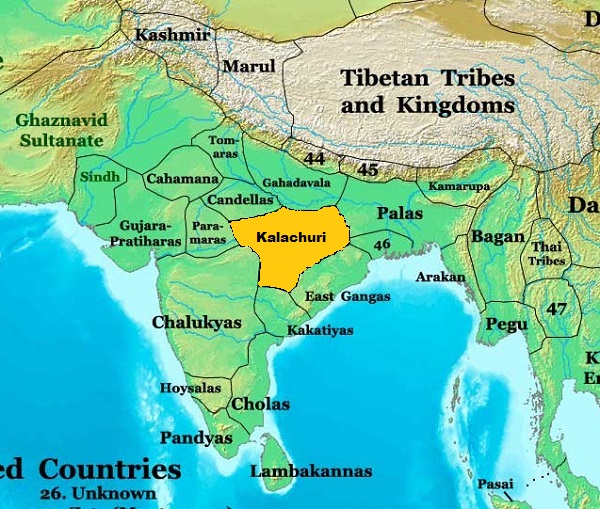
- Parmars of Malwa
- Parmars established an Independent Kingdom in 848 AD by Siyaka
- Bhoj is considered as greatest Parmar King. He was a contemporary of Rajendra Chola and had entered into an alliance with Cholas against Chalukyas.
- Raja Bhoj assumed the title of "Parmeswar Param Bhattarika". He was also a great scholar who wrote many books on Grammar, yoga, and Chemistry. He founded the city of Bhojpur in Madhya Pradesh and Bhojeswar temple.
- Chandels of Bundelkhand
- The chandel dynasty was founded by Nanuka in the 9th century. They were originally feudatories of Pratihars under Yasovarman, and Bundelkhand (Jejabhukti) became an independent kingdom.
- Their capital was Khajuraho which is known for its grand Architecture such as the Kandariya Mahadeo temple. It was built during Vidhyadhar 1003-1035 AD.
- The last powerful Ruler was Parmardi who was attacked by Prithvi Raj Chauhan.
- The dynasty came to an end because of attacks from Delhi Sultans.
- Solankis of Gujarat
- The dynasty was founded by Mularaja I, one of the great rulers was Bhima I (1024- 1064). Bhima I built a sun temple of Modhera. After his death, his queen Udaymati constructed "Rani ki Vav" (Queen's stepwell).
- Mahmud of Ghazni attacked Somnath during the reign of Bhima I.
TURKISH CONQUEST OF INDIA (06:07 PM)
- In the 12th century, two new powers emerged in central Asia and Persia i.e. Khwarzimi Empire in Persia (Iran) and Ghurid Sultanate in Afghanistan.
- In 1173 AD, Muizuddin Muhammad Sar (Muhammad Ghori) Ascended the throne. He wanted to emulate the success of Mahmud of Ghazni. He attacked Gujarat in 1178 AD, however, was defeated in the battle of Kasharda by an army of Solanki King Bal Mulraj. Mulraj was the child, and his mother Nayika Devi was the regent Queen.
- After this defeat, Ghori built a strong base in Punjab. Meanwhile, Chauhans had captured Delhi from Tomars and Prithvi Raj Chauhan wanted to expand his kingdom to Punjab
- The first Battle of Tarain occurred between the Army of Prithvi Raj Chauhan and Mohammed Ghori over the rival claims of Tabarhind Fort, Bhatinda (Punjab). Ghurid forces were completely routed, however, there was a little attempt from Prithvi Raj Chauhan to further consolidate his position in Punjab.
- The second battle of Tarain proved to be a turning point in Indian history, Ghori was victorious, and Prithvi Raj Chauhan was allowed to rule, however later killed.
- Ghori left Indian affairs in the hand of his trusted slave, Qutub-Ud-Din-Aibek, who later attacked Gujarat, Bihar, parts of MP, and Rajasthan.
- Another military commander Bakhtiyar Khilji attacked Bengal, which was ruled by Lakshman Sena of the Sena dynasty. Bakhtiyar Khilji destroyed the University of Nalanda and Vikramshila. He wanted an expedition to Tibet. He attacked the Kamrup Kingdom but was completely overwhelmed by Raja Prithu Rae of the Kher dynasty
- Mohammad Ghori was killed by one of the Khokhar assassins. Khokhars were a tribe from Punjab. After his death, Qutub-Ud-Din Aibek declared himself to be an independent ruler with Lahore as the capital.
- Causes of the defeat of Rajputs (06:39 PM)
- The growth of feudalism has weakened the military organization of rulers.
- They were dependent upon local chiefs who rarely coordinated with each other.
- Rajputs fought among themselves while Turkish slaves were loyal and Trustworthy.
- Turks had superior horses, Mounted archers and they could move as an organized body of horsemen.
- Rajputs did not attempt to take back the outer bastions of India such as Lahore, Peshawar, and Kabul despite defeating the Turks, a number of times.
DELHI SULTANATE (07:02 PM)
SLAVE DYNASTY/ MAMLUK DYNASTY
- Qutub-Ud-Din-Aibek (1206-10)
- He ruled from Lahore after severing his link with Ghazni. He is credited for starting the construction of Qutub Minar, and Adhai Din ka Jhopra.
- He died playing Chaugan (Horse Polo)
- Iltutmish (1211-1236)
- Iltutmish was the son-in-law of Qutub-Ud-Din-Aibek who defeated the son of Qutub-Din- Aibek, Aram Shah and became Sultan
- He shifted the capital to Delhi. Turk commanders had declared their independence in Punjab, Bihar, and Bengal. He defeated Ali Mardan in Punjab and Qubacha in Bengal.
- He also instituted Turkan-e-chahalgani, a group of 40 Turkish Nobles to help in the administration. He was a contemporary of Ghengis Khan, the founder of the Mongol empire.
- Iltutmish implemented the Iqta system of administrative grants.
- He nominated his daughter Raziya to become the next ruler as he did not consider his sons to be worthy of rule.
- Two basic coins of Sultanate Silver Tanka and copper Jittal were used
- Raziya (1236-1239)
- Raziya had to contend against her brothers as well as Ulemas and Nobles.
- Some of the Turkish Nobles supported her claim in the hope of a puppet ruler but Raziya started asserting her authority, for example
- a) She issued coins in her name, removed veils from her court
- b) Made public appearances on elephant
- c) She appointed Non-Turks to key positions. For example- A person named Yakuth was appointed as Amir-e-Akhoor, caretaker of the Royal Stables.
- d) She led the successful campaign to Lahore however while returning she was arrested in another rebellion. She married one of her captors Altunia and tried to reclaim Delhi but was defeated and killed later while on the run.
- Balban (1265-1287 AD)(07:42 PM)
- By carefully removing all the opposition Balban declared himself as Sultan in 1265 AD. He became a champion of the Turkish nobility.
- He excluded all non-turks including Indian Muslims from power and Authority.
- He broke up the Turkan-e-Chahalgani.
- He started the Iranian method of Sijda and Paibos to the sultan in India and also introduced the Persian festival Nauroj.
- He employed spies called Barids to inform about his officials. These spies were only answerable to Sultan.
- At this time, there was a fear of Mongol invasion, so the empire of Genghis Khan was divided among his sons and Grandsons called Khanate.
- In 1241 Mongols invaded Lahore.
- After becoming sultan, Balban adopted both forces and diplomacy in one of the Mongon Aggression. His elder son Mahmud was killed. However, the arrangements done by Balban were very helpful for later rulers. For example- During the time of Allaud-din Khilji in 1299 AD, Mongols entered Delhi and sacked the streets of the city. Alla-ud-Din Khiji was able to Repulse this invasion and in 1303 AD, he had a decisive victory against the Mongols.
- After the death of Balban, his son Bughra Khan (Governor of Bengal) was called to become the next Sultan but he refused. The grandson of Balban Samsuddin was appointed as Sultan, however, he was dethroned by Jalal-ud-din Khilji.
KHILJI DYNASTY (1290-1320) (08:03 PM)
- Khiljis were of Turkish Afghan origin who despite their role in resisting Mongol Invasion were not recognized in Delhi.
- Jalal-Ud-Din Khilji (1290-96) was welcomed by Non-turkish Nobility. He adopted a policy of tolerance and avoided harsh punishments.
- However, he was treacherously killed by his nephew and Son-in-law, Ala-ud-din Khilji.
- Ala-Ud-Din-Khilji (1296- 1316 AD)
- He was a ruthless ruler who gave severe punishments even to his own family.
- He took a series of measures to strengthen his army and prevent the nobles from conspiring against him.
- His military campaign included Gujarat, Ranthambhore, Chittor, and Malwa.
- His slave General Malik Kafur led multiple campaigns in Deccan and South. He looted huge amounts of wealth from Devagiri (ruled by the Yadava dynasty), Dwarasamudram (ruled by Hoysalas), Madurai (ruled by Pandyas), and Warangal (Ruled by Kakatiyas).
The Topic for the next class:- Market reforms of Ala-ud-din Khilji, Regional kingdoms, Vijaynagar empire, and Bahamani kingdom.